

The Hidden Cost of Complexity
Running a modern hotel is already complex. From reservations to housekeeping, marketing, distribution, and guest communication. Every touchpoint matters. But too often, hotels rely on a patchwork of disconnected systems: one provider for the PMS, another for channel management, a different tool for direct bookings, and yet another for guest engagement.
This “spaghetti stack” of software increases costs, creates inefficiencies, and frustrates staff and guests alike. The hospitality industry is waking up to the reality that too many tools are slowing down, not speeding up, operations.
The solution? A single, integrated platform that simplifies hotel technology.
Why Hotel Tech Stacks Became So Fragmented
- Legacy silos: PMS, CRS, IBE, and channel managers were originally built as stand-alone solutions.
- Vendor overload: Hotels kept adding niche providers to patch gaps (loyalty tools, chatbots, revenue managers).
- Integration pain: APIs help, but frequent sync issues and data mismatches cause headaches.
- Hidden costs: More providers is more contracts, more training, more support tickets.
What started as “flexibility” has turned into an operational burden.
The Risks of Too Many Systems
- Operational inefficiency: Staff switching between multiple dashboards wastes time.
- Data fragmentation: Guest and booking data gets stuck in silos, blocking insights.
- Revenue leakage: Delays or errors in channel syncing can lead to lost bookings.
- Inconsistent guest experience: Disjointed tools can’t deliver a seamless journey.
- Rising costs: Each provider adds subscription fees, integration costs, and training overhead.
Hotels need to ask: is tech complexity helping or hurting business growth?
The Case for Simplification: One Platform, One Contract
Hotels increasingly prefer platform providers over patchwork solutions. Why?
- All-in-One Operations: A central PMS that connects reservations, housekeeping, payments, and reporting.
- Revenue Management & Distribution: Direct booking engines (IBE) and OTA channel management under one umbrella.
- AI-Powered Efficiency: Content creation, translations, and guest communications streamlined with AI tools.
- Scalability: Multi-property chains and soft brands managing everything from a single dashboard.
- Cost & Time Savings: One vendor, one contract, one support partner.
By consolidating, hoteliers free staff to focus on what matters most: delivering exceptional guest experiences.
What Simplification Looks Like in Practice
Imagine this:
- Your PMS updates automatically across all OTAs.
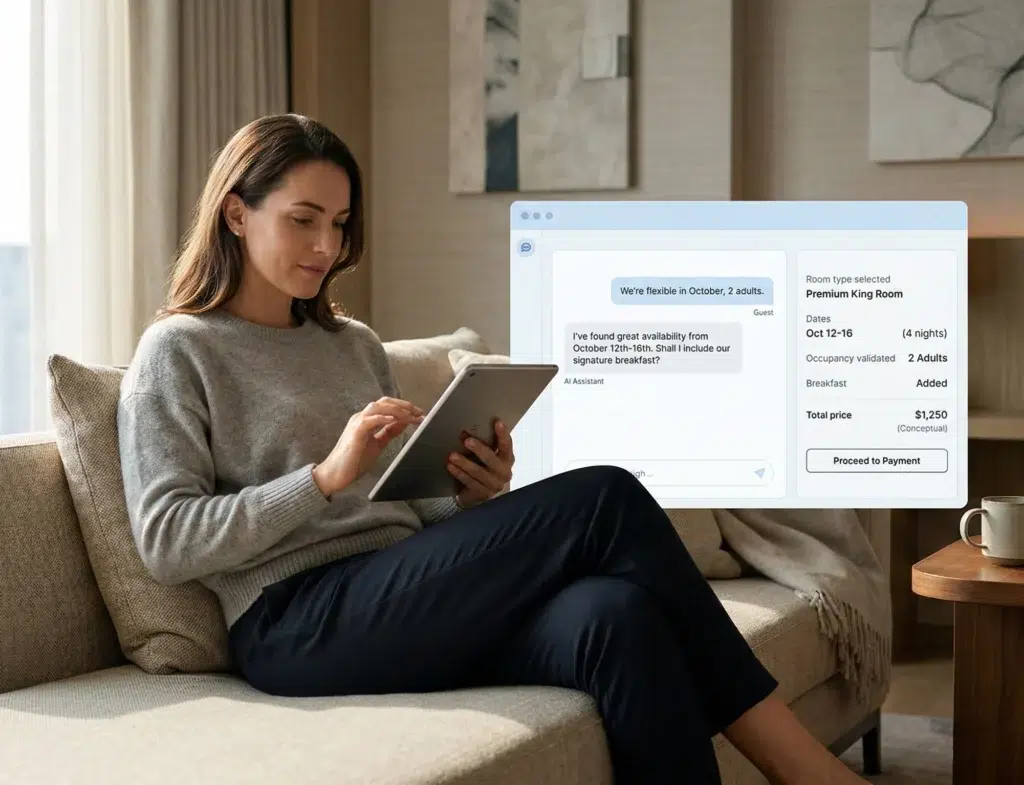
- Guests receive AI-personalized booking experiences.
- Multi-property management happens in a single dashboard.
- Marketing campaigns target multiple guest personas with ease.
- A voice concierge handles routine guest queries 24/7.
This isn’t just possible, it’s already here.
Conclusion: The Future Belongs to the One-Platform Hotel
As hospitality evolves, hotels that streamline technology will win. The era of juggling 6+ different providers is ending. Efficiency, revenue growth, and guest satisfaction require integration, not fragmentation.
Seekda Sphere is built on this vision: one platform, one partner, one contract.
Learn more about Seekda’s Solutions:
- Seekda Sphere – Property Management System
- SeekdaPay – The payment solution build for hospitality
- Seekda Stay – 24/7 voice concierge
- Seekda Booking Engine (KUBE)
- Seekda Channel Manager
- External link: HospitalityNet – Key Hospitality Technology Trends for 2025
Overview of the most important hospitality technology trends, including AI, IoT, automation, and personalization. https://www.hospitalitynet.org/news/4125209.html - External link: Phocuswright – Travel Innovation and Technology Trends 2025
A forward-looking report covering travel technology, digital identity, and generative AI trends in hospitality. https://www.phocuswright.com/Travel-Research/Research-Updates/2025/Travel-Innovation-and-Technology-Trends-2025
A hotel tech stack is the collection of software solutions hotels use to manage operations, sales, distribution, and guest experiences. It typically includes PMS, booking engines, channel managers, and guest engagement tools.
Because hotels often add new providers for each specific need, leading to multiple systems that don’t always integrate smoothly. This creates inefficiencies, higher costs, and data silos.
Hotels can simplify by adopting an all-in-one platform that combines PMS, distribution, booking engines, and guest services under a single contract and interface.
Benefits include reduced costs, fewer integration issues, better data visibility, improved guest experiences, and easier scalability for multi-property operations.
Yes. AI can automate content creation, handle guest queries, optimize bookings, and deliver personalized experiences. Reducing manual work and system overload.